
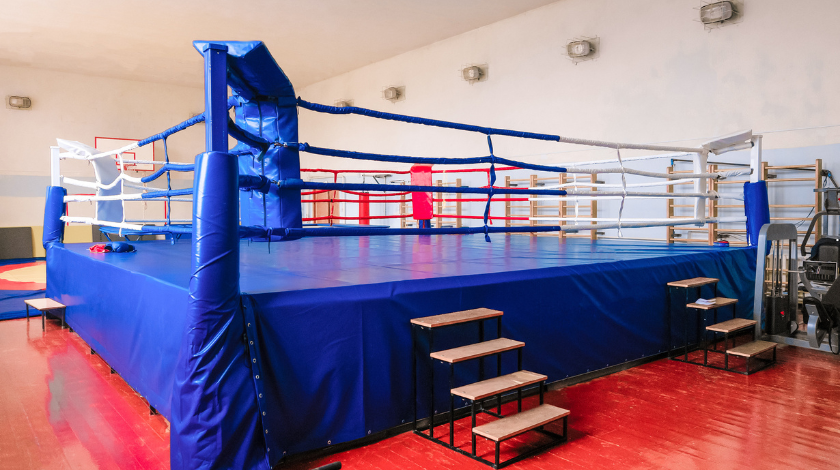

A Boxing Boxing Ring is the designated competition area where boxing matches take place. Despite its name, a modern boxing ring is actually a square platform enclosed by four ropes attached to corner posts. The term “ring” dates back to the early days of prizefighting, when spectators formed a circular ring around the fighters. As boxing evolved into a regulated sport, organizers adopted square platforms because they were easier to construct, offered better visibility for spectators, and provided consistent boundaries for competition. Even though the shape changed, the traditional name remained, giving us the familiar phrase “stepping into the ring.”
Today’s boxing ring is far more than a raised platform. Every component from the padded canvas and corner posts to the tension of the ropes is designed with athlete safety and fair competition in mind. The ring creates a controlled environment where boxers can move strategically while referees, judges, and medical personnel have clear access. Whether the match takes place in a local gym, a national championship, or a world title event, the ring is the centerpiece of the competition and one of the sport’s most recognizable symbols.
History of the Boxing Ring
The history of the boxing ring reflects the evolution of boxing itself. During the eighteenth and nineteenth centuries, many bare-knuckle contests were held outdoors with spectators simply gathering in a circle around the fighters. These informal rings had no ropes, padding, or standardized dimensions. As boxing became more organized under formal rules, enclosed platforms with ropes were introduced to improve safety, define the fighting area, and keep competitors inside the contest space.
The adoption of the Marquess of Queensberry Rules in the late nineteenth century accelerated the move toward standardized rings. Over time, organizers introduced padded corner posts, resilient canvas surfaces, and stronger rope systems to reduce injuries. Today’s professional and amateur boxing rings follow strict technical standards established by athletic commissions and governing bodies, ensuring consistency and safety across competitions worldwide.
Anatomy of a Boxing Ring
Every boxing ring consists of several carefully engineered components that work together to create a safe and functional competition area. The raised platform supports the entire structure and is covered with thick padding before a tightly stretched canvas is installed. This padding helps absorb impact when fighters fall while maintaining a stable surface for footwork.
The ropes are another critical feature. Most modern boxing rings use four padded ropes attached to reinforced corner posts. These ropes help prevent fighters from falling out while allowing enough flexibility to absorb force during exchanges. Each corner is color-coded, with red and blue corners assigned to opposing boxers and the remaining corners typically designated as neutral. Properly padded turnbuckles and corner posts reduce injury risk during high-speed movement around the ring. Athletic regulations also require sturdy construction, clean surfaces, and regular inspections before sanctioned events.
Standard Boxing Ring Dimensions
One of the most common questions is, “How big is a boxing ring?” The answer depends on whether the event is amateur or professional and which athletic commission oversees the competition.
Professional boxing rings commonly measure 18 to 22 feet (5.5 to 6.7 meters) inside the ropes, while many championship events use 20-foot rings. Athletic commissions often require an apron extending beyond the ropes for additional safety and adequate padding beneath the canvas.
Amateur competitions generally use slightly smaller rings, often ranging between 5 and 6 meters (approximately 16.4 to 19.7 feet) inside the ropes. Safety regulations typically specify padded flooring, secure corner posts, and minimum rope spacing to protect competitors.
Typical Boxing Ring Dimensions
| Feature | Professional | Amateur |
|---|---|---|
| Ring size (inside ropes) | 18–22 ft | 5–6 m (16.4–19.7 ft) |
| Number of ropes | 4 | 3–4 (depending on rules) |
| Platform height | Up to 4 ft | Varies by federation |
| Corner colors | Red, Blue, 2 Neutral | Red, Blue, 2 Neutral |
Boxing Ring Materials
Modern boxing rings combine strength, durability, and safety. The structural frame is usually manufactured from heavy-duty steel capable of supporting athletes, officials, and equipment. High-density foam or similar impact-absorbing material covers the platform before the canvas is installed.
The canvas itself must remain smooth, tightly stretched, and free from wrinkles that could create tripping hazards. Corner padding uses thick foam wrapped in durable vinyl, while ropes feature protective coverings to reduce abrasions during competition. Premium rings often use weather-resistant coatings, making them suitable for both indoor arenas and outdoor promotional events.
How a Boxing Ring Is Built
Building a boxing ring requires careful planning and precision. Construction begins by assembling the steel frame and securing adjustable supports to ensure a perfectly level platform. Protective padding is then installed across the entire surface before the canvas is stretched tightly over the platform and secured underneath.
After the floor is complete, corner posts are mounted, ropes are tensioned evenly, and all turnbuckles receive protective padding. Every connection point is inspected to confirm stability before the ring is approved for use. Regular maintenance is equally important. Event organizers inspect ropes, tighten hardware, replace worn padding, and clean the canvas before each competition to maintain safety standards and professional presentation.
Boxing Ring Rules
Although boxing rules vary slightly between organizations, most competitions share several common requirements regarding the ring itself.
- The ring must be square and securely constructed.
- The floor must include protective padding beneath the canvas.
- Corner posts and turnbuckles must be fully padded.
- Ropes must be securely tensioned and wrapped with protective material.
- Rings are inspected before sanctioned events to verify compliance with safety standards.
These standards help minimize injury risk while providing a consistent environment for athletes competing at every level.
Buying a Boxing Ring
Choosing the right boxing ring depends on your intended use. A home gym may only require a compact training ring, while professional promotions need regulation-sized equipment that meets athletic commission requirements. Buyers should consider available space, build quality, portability, warranty coverage, and compliance with local competition rules before making a purchase.
Portable rings have become increasingly popular because they can be assembled and disassembled quickly for tournaments, exhibitions, and fitness centers. Permanent installations, however, generally provide greater structural stability and long-term durability for facilities hosting regular events.
Conclusion
The boxing ring represents much more than a place where two athletes compete. It combines engineering, safety, tradition, and sporting history into one carefully designed structure. From its origins as a simple circle of spectators to today’s highly regulated square platform, the boxing ring has evolved alongside the sport while preserving its iconic identity.
Whether you’re a boxer, coach, promoter, or enthusiastic fan, understanding boxing ring dimensions, construction, materials, and safety standards provides valuable insight into one of combat sports’ most recognizable symbols. Every rope, corner, and section of canvas contributes to creating an environment where skill, strategy, and determination can take center stage.
Frequently Asked Questions
1. Why is a boxing ring called a ring if it’s square?
The name comes from early prizefights where spectators formed a circular ring around the competitors before square platforms became standard.
2. What is the standard size of a professional boxing ring?
Most professional rings measure 18 to 22 feet inside the ropes, with 20 feet being a common championship size.
3. How many ropes does a boxing ring have?
Modern professional boxing rings typically use four padded ropes surrounding the platform.
4. What material covers the boxing ring floor?
The floor consists of protective padding covered by a tightly stretched canvas surface designed for traction and impact absorption.
5. Can boxing rings be used outdoors?
Yes. Many manufacturers offer weather-resistant rings suitable for temporary outdoor events, provided they are installed on a stable surface and protected from extreme weather.