
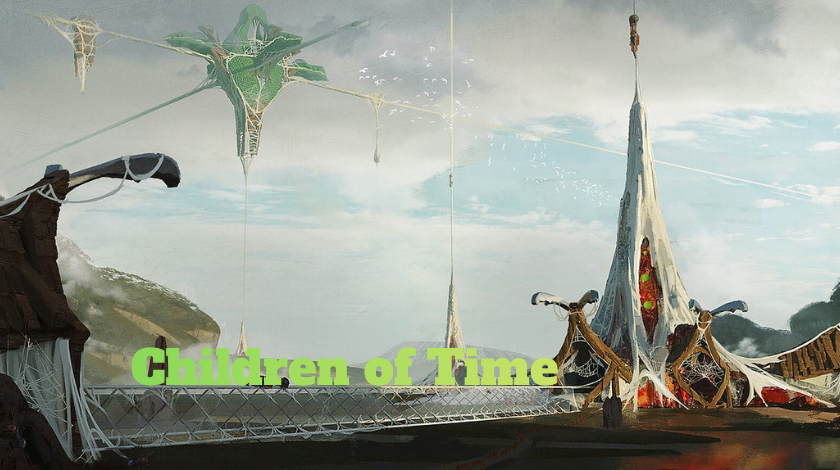

Science fiction often asks a simple question: What happens next? Children of Time by Adrian Tchaikovsky takes that question to an extraordinary level by imagining the future of humanity after Earth has declined and another intelligent species rises to prominence. First published in 2015, the novel combines evolutionary biology, artificial intelligence, first-contact storytelling, and space exploration into a sweeping narrative that has become one of the most celebrated science fiction novels of the 21st century. The book won the 2016 Arthur C. Clarke Award and has since grown into a bestselling series that now includes Children of Ruin (2019), Children of Memory (2022), and Children of Strife (2026).
What makes Children of Time remarkable isn’t simply its ambitious world-building. It’s the way Adrian Tchaikovsky transforms creatures that many people fear spiders into believable, sympathetic protagonists with a richly developed civilization. The novel alternates between the desperate journey of humanity’s last survivors and the gradual evolution of intelligent spiders on a terraformed planet. These parallel storylines eventually collide in ways that challenge traditional ideas about intelligence, morality, and survival. Whether you’re a lifelong science fiction reader or someone searching for an unforgettable novel filled with big ideas, Children of Time offers an experience that remains difficult to match.
Introduction to Children of Time
At first glance, Children of Time may appear to be another futuristic survival story. Humanity has devastated Earth and launches missions to terraform distant worlds before civilization collapses. Thousands of years later, the remnants of humanity travel aboard an ark ship searching for a habitable planet. What they expect is a ready-made paradise left behind by their ancestors. Instead, they discover that evolution has rewritten the rules. The world is no longer waiting for humans. Another civilization has already claimed it.
Rather than relying solely on fast-paced action, the novel carefully explores how intelligence develops over time. Readers witness thousands of years of biological and cultural evolution among genetically enhanced spiders. Their society advances from primitive hunting communities to technologically sophisticated civilizations, all while remaining distinctly non-human. This perspective gives the novel unusual emotional depth and intellectual richness. It also explains why many critics describe Children of Time as one of modern science fiction’s most imaginative works.
Why the Novel Has Become a Modern Sci-Fi Classic
The novel succeeds because it blends scientific realism with compelling storytelling. Evolution isn’t simply background information it drives every major event in the narrative. Instead of treating alien intelligence as something mysterious or magical, Adrian Tchaikovsky demonstrates how intelligence might naturally emerge under different environmental conditions. Readers frequently praise this approach because it feels scientifically grounded while remaining emotionally engaging. Community discussions also highlight the novel’s ambitious scope, with many readers calling it one of the defining science fiction books of recent years.
About the Author
Who Is Adrian Tchaikovsky?
Adrian Tchaikovsky is one of Britain’s most respected science fiction and fantasy authors. Before becoming a full-time writer, he studied zoology and psychology, academic backgrounds that strongly influence his fiction. His fascination with insects, spiders, and animal behavior appears throughout many of his novels, but nowhere more prominently than in Children of Time. His ability to combine scientific knowledge with imaginative storytelling has earned him numerous literary awards and an international readership.
His Inspiration Behind the Novel
Rather than portraying spiders as monsters, Tchaikovsky imagined what would happen if they became the dominant intelligent species on a planet originally intended for humans. This unusual premise allows him to examine familiar human ideas—politics, religion, cooperation, war, and technological innovation—from an entirely different perspective. The result is a novel that feels fresh even to experienced science fiction readers because it challenges assumptions about civilization itself.
Publication History
Awards and Recognition
Children of Time received widespread critical acclaim shortly after publication. It won the prestigious Arthur C. Clarke Award for Best Science Fiction Novel in 2016 and has since become one of Adrian Tchaikovsky’s signature works. Critics praised its originality, enormous scale, and thoughtful exploration of evolution and intelligence. Authors including Patrick Ness and physicist Jim Al-Khalili have also commended the novel’s imagination and emotional depth.
The Expanding Children of Time Universe
The success of the first novel inspired an expanding series:
| Book | Publication Year | Focus |
|---|---|---|
| Children of Time | 2015 | Humanity and intelligent spiders |
| Children of Ruin | 2019 | New alien intelligence |
| Children of Memory | 2022 | Memory, identity, and lost colonies |
| Children of Strife | 2026 | Another exploration of humanity’s forgotten worlds |
The series continues to grow, demonstrating both commercial success and sustained reader interest.
Plot Overview
Humanity’s Last Hope
The human storyline follows the ark ship Gilgamesh, carrying the last survivors of civilization through deep space. Resources are limited, internal conflicts threaten the mission, and hope grows increasingly fragile. Their destination is a planet prepared centuries earlier through a terraforming experiment. What begins as a rescue mission gradually transforms into a struggle over who truly deserves to inherit the future.
The Evolution of Intelligent Spiders
Running parallel is the extraordinary story of Portia labiata spiders that evolve into a highly advanced civilization after exposure to an engineered virus. Readers observe thousands of years of scientific discovery, social development, political conflict, and cultural transformation. Rather than behaving like humans with eight legs, these spiders develop their own communication methods, technologies, and philosophies. This evolutionary narrative is widely regarded as one of the novel’s greatest achievements because it feels both imaginative and biologically plausible.
Main Characters
Human Protagonists
The novel features several memorable human characters whose perspectives shift across centuries due to advanced life-extension technologies and cryogenic sleep. Their personal ambitions, fears, and moral dilemmas reflect humanity’s desperate attempt to survive despite repeated mistakes. Rather than presenting humans as flawless heroes, the novel explores both the strengths and weaknesses of civilization.
The Spider Civilization
Perhaps the true protagonists are the spiders themselves. Characters such as Portia, Bianca, and Fabian represent different stages in their civilization’s development. Their stories reveal scientific curiosity, courage, cooperation, and innovation. Readers often report becoming surprisingly attached to these characters despite their non-human nature a testament to Tchaikovsky’s skill as a storyteller.
Major Themes
Evolution and Survival
Evolution is the novel’s central theme. Intelligence emerges not through destiny but through adaptation, cooperation, and environmental pressures. The book suggests that survival belongs not necessarily to the strongest species but to those most capable of learning and changing. This perspective encourages readers to reconsider humanity’s place within the broader history of life.
Artificial Intelligence and Civilization
Artificial intelligence also plays a significant role through systems left behind by ancient terraformers. These machines influence events across millennia while raising questions about responsibility, memory, and technological legacy. Combined with discussions of ethics and scientific progress, these ideas give Children of Time philosophical depth rarely found in conventional adventure novels.
Why Readers Love Children of Time
Readers consistently praise the novel for its originality, emotional impact, and ambitious scientific ideas. Online discussions reveal that although some find the opening chapters challenging because of the novel’s complex structure, many ultimately consider it among the finest modern science fiction books they’ve read. Others particularly appreciate the balance between intellectual exploration and compelling storytelling.
Professional reviewers likewise highlight the novel’s remarkable imagination. The tenth-anniversary edition released in 2025 further renewed interest in the series, introducing new readers to a story that continues to influence contemporary science fiction.
Reading Order of the Series
For the best experience, read the books in publication order:
- Children of Time
- Children of Ruin
- Children of Memory
- Children of Strife
Each novel builds upon previous events while introducing new civilizations, scientific concepts, and ethical questions. Although each book tells a largely self-contained story, reading them sequentially provides a richer understanding of the evolving universe.
Conclusion
Children of Time stands as one of the defining science fiction novels of the modern era because it combines scientific imagination with deeply human storytelling. Adrian Tchaikovsky transforms concepts such as evolution, artificial intelligence, ecology, and first contact into an unforgettable narrative that challenges readers to rethink what intelligence truly means.
Years after its original publication, the novel continues attracting new readers through award recognition, enthusiastic recommendations, and an expanding series. Whether you’re fascinated by speculative biology, epic space exploration, or philosophical science fiction, Children of Time delivers an experience that is both intellectually stimulating and emotionally rewarding.
FAQs
1. Is Children of Time part of a series?
Yes. It is the first novel in the Children of Time series, followed by Children of Ruin, Children of Memory, and Children of Strife.
2. Who wrote Children of Time?
The novel was written by Adrian Tchaikovsky, an award-winning British science fiction and fantasy author.
3. Did Children of Time win any awards?
Yes. It won the 2016 Arthur C. Clarke Award for Best Science Fiction Novel.
4. Is Children of Time suitable for beginners to science fiction?
Yes, although it explores complex ideas, many readers consider it an excellent introduction to modern hard science fiction because it balances scientific concepts with engaging characters.
5. Is there a movie adaptation of Children of Time?
As of 2026, there is no released film adaptation. The novel was previously optioned for adaptation, but no completed production has been announced.